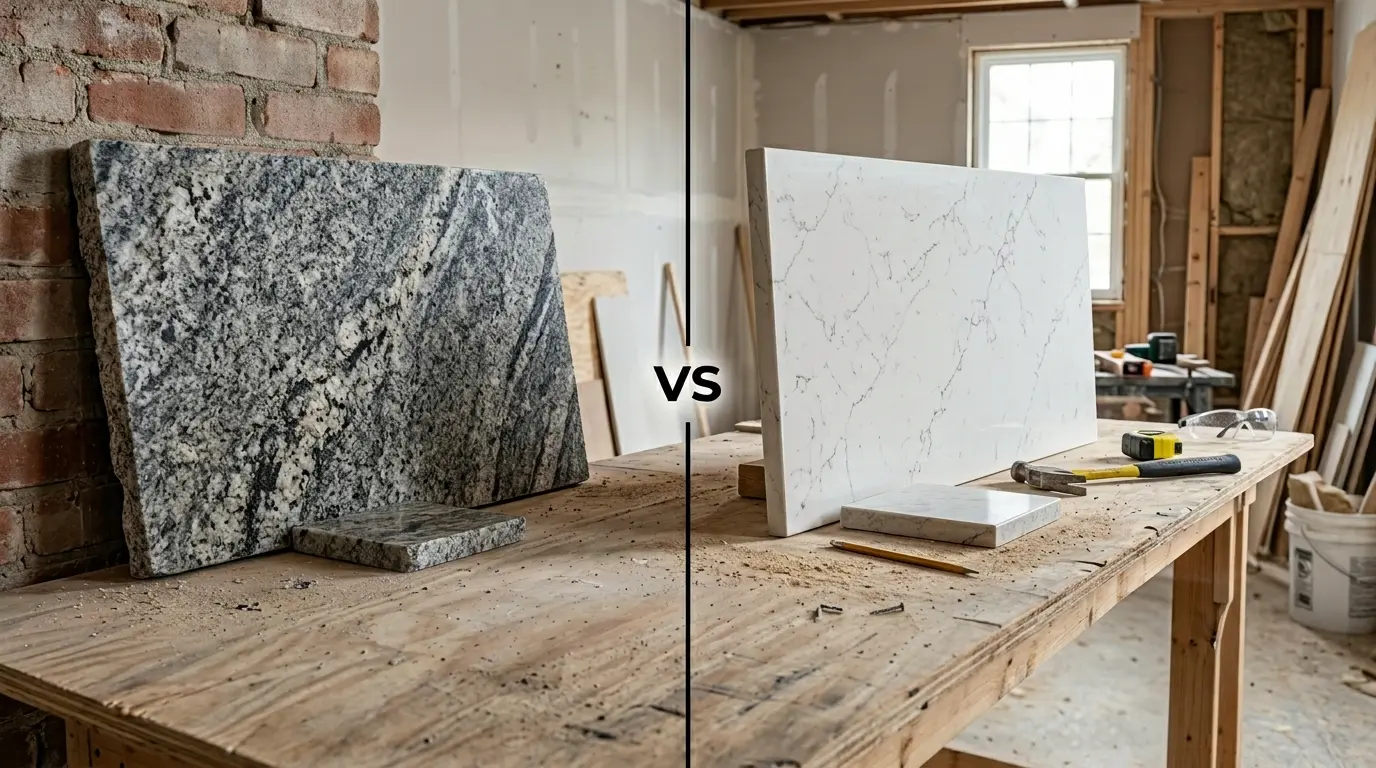
Picking between granite countertops and quartz countertops is the biggest material decision in most Virginia kitchen remodels. Both look good in the showroom. Both come with marketing claims about being the best stone for your kitchen. The reality is more practical: each one wins on certain things and loses on others, and the right choice depends on how you actually use your Virginia kitchen day to day. After fabricating and installing thousands of square feet of stone countertops in Virginia, Maryland, and DC kitchens, we've seen what holds up over a decade and what shows wear at year three. This guide compares the two on the things that actually matter: durability, maintenance, price, appearance, and how each performs in a real Virginia kitchen.
Granite Countertops in Virginia Kitchens: What You're Getting
Granite is a natural igneous rock cut from quarries around the world. Every slab is one of a kind. The veining, the color blend, the way light hits the polished surface, all of it varies. If you walk into a Virginia stone yard and pick a granite slab, that exact stone goes into your kitchen. Granite handles heat. You can set a hot pan directly on it without damage. It resists scratches better than almost any other countertop material. The downside is porosity. Granite needs sealing every one to three years to keep liquids out. Without sealant, red wine, oil, and coffee can soak into the surface and stain. Polished granite hides minor wear better than honed or leathered finishes, which is why most Virginia kitchens with granite go polished.
Quartz Countertops in Virginia Kitchens: What You're Getting
Quartz countertops are engineered. Around 90 to 95 percent ground natural quartz is mixed with resin and pigments to create slabs. The result is consistent color and pattern from slab to slab, which matters if you want a uniform look in your Virginia kitchen. Quartz wins on stain resistance and zero maintenance. No sealing, ever. Liquids sit on the surface until you wipe them off. Bacteria can't soak in because there's nothing porous. The downside is heat sensitivity. The resin in quartz can discolor or melt if you set a hot pan directly on it, so trivets aren't optional. Quartz is also slightly less scratch-resistant than granite, though most Virginia homeowners never notice the difference in daily use.
Price Difference Between Granite and Quartz in Virginia
Pricing in Virginia for both stones overlaps more than people expect. Basic granite runs $40 to $80 per square foot installed. Mid-range granite, with better veining or rarer colors, runs $80 to $150 per square foot. Premium granite slabs from Italy, Brazil, or India can push past $200 per square foot. Quartz pricing in Virginia kitchens runs $60 to $100 per square foot for basic colors, $100 to $150 for popular patterns from Caesarstone, Silestone, or Cambria, and $150 to $250 for premium designer lines that mimic marble or rare stones. Installation costs are similar for both. Templating, fabrication, sink cutouts, and edge profiles are the same labor either way. The big price drivers are slab color, source, and brand premium.
Which Stone Wins for Your Virginia Kitchen
The honest answer is it depends on how you cook and what you care about. If you set hot pans down without thinking, granite countertops handle it better. If you spill red wine and don't wipe it up for an hour, quartz countertops will be cleaner the next morning. If you want one-of-a-kind veining that nobody else has, granite wins. If you want consistent color that matches the cabinets exactly, quartz wins. For most Virginia families with kids, pets, and busy weeknight cooking, quartz is the easier daily countertop. For Virginia homeowners who entertain, cook on high heat, and like the natural stone look, granite is hard to beat. Some Virginia kitchens use both: granite on the main perimeter, quartz on the island.
Frequently Asked Questions
Is granite or quartz more durable in a Virginia kitchen?
Both are highly durable. Granite handles heat better; quartz handles stains better. For typical daily use in a Virginia kitchen, both will last 20 plus years if installed properly.
Does granite or quartz add more value to a Virginia home?
Either one adds value compared to laminate or tile. Quartz has become more popular in newer Virginia kitchens, but granite still resells well, especially in higher-end homes with traditional design.
Do you need to seal quartz countertops in Virginia?
No. Quartz is non-porous and doesn't need sealing. Granite needs sealing every one to three years depending on the slab and how much liquid it sees.
Can you put hot pans on granite or quartz?
On granite, yes. Granite handles direct heat without damage. On quartz, no. The resin can discolor or warp. Always use a trivet on quartz countertops.
What's the most popular kitchen countertop in Virginia right now?
Quartz has been the top pick in most Virginia kitchen remodels over the past five years, with white and gray patterns leading the demand. Granite still wins in higher-end and traditional homes.